
CAT 2025 Exam - Profit & Loss Questions With Solutions, LR & DI | Day 9
CAT is a highly competitive exam for admission to top B-schools like the IIMs. As part of our 60-day preparation series, Day 9 focuses on Profit & Loss and Logical Reasoning & Data Interpretation (LR & DI). This guide offers key concepts, solved examples, and practice sets to improve accuracy and speed. It aims to strengthen your understanding and enhance your ability to solve these questions confidently within CAT 2025's time constraints.
thi sis test live blog thi sis test live blog
Part-1: Quantitative Aptitude for CAT 2025 Topic: Profit and Loss
Today, we are here with the extended part of the percentage, i.e., Profit and Loss. The Percentage is the basic building block of Arithmetic. Profit and Loss CAT questions are one of the most important topics for the CAT Exam. To solve the CAT Profit and Loss questions, you must first understand the basics of Profit and Loss. We can understand the basics well with the help of the profit triangle, as shown below:
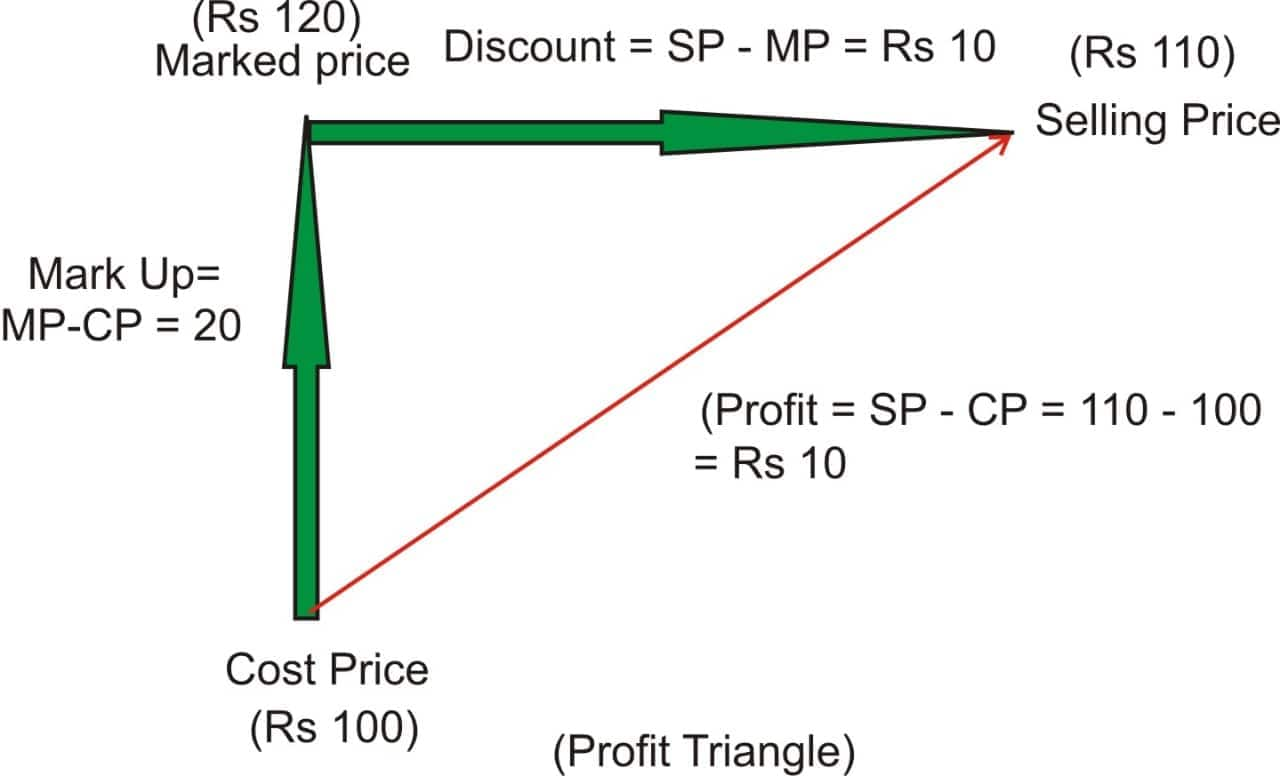
The price at which we purchase something is the "cost price" (CP).
The price that we mark or print on the article is the marked price (MP).
The price at which we sell something is its selling price (SP).
Marked Up % = (MP-CP) x100/CP
Discount % = (MP-SP) x100/MP
Profit % = (SP-CP) x100/CP
If SP is less than CP, then profit is loss.
CAT Profit And ’Profit and Loss Type:
Questions involve direct calculation to find profit%, Discount% or Markup%.
Questions in which values are given in terms of profit%, Discount% or Markup%.
Any two of these are given, and the third one is asked.
Questions on successive discounts.
Questions on actual weight and faulty weights.
Questions based on adulteration.
Questions based on basic formulas only, and many more.
You have to prepare each type of Arithmetic question separately for a better understanding of the concept.
CAT Quant Questions With Solutions / Profit and Loss CAT previous year questions
The two previous year CAT questions on Profit and Loss are given below for a better understanding. The arithmetic section caries one of the greatest weightage in CAT arithmetic questions:
Q1. If a seller gives a discount of 15% on the retail price, she still makes a profit of 2%. Which of the following ensures that she makes a profit of 20%?[CAT Question Paper 2017 Slot 1]
Give a discount of 5% on the retail price
Give a discount of 2% on the retail price.
Increase the retail price by 2%.
Sell at retail price
Ans: D
15 % discount means If MP = 100; SP = 85
2 % profit means If CP = 100; SP = 102
In both SP should be same, so make them equal and we get
SP= 510, CP= 500 and MP = 600.
For 20% profit SP =600 which is equal to MP (Retail Price).
CAT Arithmetic Questions:
Q2. On selling a pen at 5% loss and a book at 15% gain, Karim gains Rs. 7. If he sells the pen at 5% gain and the book at 10% gain, he gains Rs. 13. What is the cost price of the book in Rupees? [CAT Question Paper 2019, Slot 1]
85
95
80
100
Ans: (3)
Let CP of pen = 100x; CP of book = 100y
Case 1
-5x + 15y = 7
Case 2
5x + 10y = 13
On solving both equations y = 4/5
CP of a book = 100x(4/5) = Rs 80
Prerequisite Before Practising CAT Profit and Loss Questions :
To prepare this topic for the CAT exam, students must have knowledge of
Fractions
Approximation
Tips to Prepare for CAT exam Profit and Loss questions
Learning conversions from Application of Percentage to fractions is important for this topic also.
Practice questions based on Application of Percentage well.
You can use the following tricks to solve the particular type of question:
If two articles were sold at an equal price with a profit of a% on one article while a loss of a% on another. Then, there will always be a loss of
If n articles were purchased at equal prices and sold at different prices. Then, net profit % is the average of all profit %. Loss % will be treated as negative of profit %.
In the questions of true weight/ false weight, the Selling Price has always been calculated on the reading while the Cost price has always been calculated on actual weight. After that compare the final selling price and final cost price to find profit or loss percent.
In the questions of successive discounts, use the concept of the successive percentage change.
References to Study (Theory):
Arun Sharma: A Quantitative Approach for CAT (7th Edition, Pg No: 235 - 242)
2iim Online Learning Classroom
References to Practice CAT Arithmetic Questions:
Quantitative Aptitude book by Abhijit Guha.
CAT previous year papers
Part-2: Logical Reasoning and Data Interpretation: Topic: Data Interpretation (Miscellaneous)
Previously, we have discussed general types of data interpretation. In this article, we are going to discuss the miscellaneous types of data interpretations for the CAT exam, like
Multi-Layered Pie Chart
Double Bar Graphs
Logic Based DI (most common in recent years)
Combination of two or more types of graphs in a single DI
i.e. table with a pie chart, line graph with bar graph, etc.
Such graphs are used to represent more data on a single graph.
In the CAT Exam and other management entrance exams, data interpretation is a must-come topic.
Preparing DI involves three basic steps:
Understanding Charts and Graphs
Understanding the logic or concept (More required in multi-layered DI and Caselet DI)
Be good at calculations.
Questions Based On Data Interpretation From CAT Previous Year Papers Comprehension:
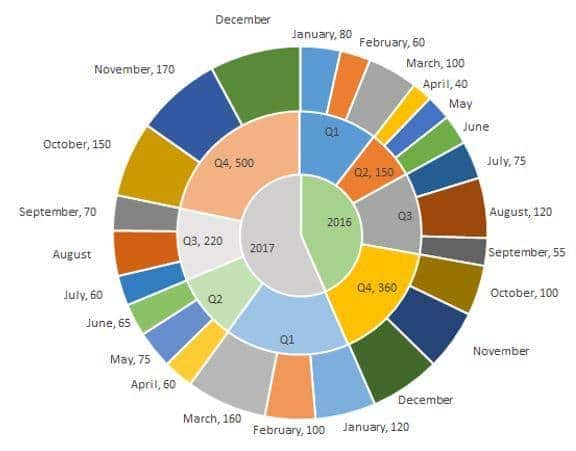
The multi-layered pie-chart below shows the sales of LED television sets for a big retail electronics outlet during 2016 and 2017. The outer layer shows the monthly sales during this period, with each label showing the month followed by the sales figure of that month. For some months, the sales figures are not given in the chart. The middle-layer shows quarter-wise aggregate sales figures (in some cases, aggregate quarter-wise sales numbers are not given next to the quarter). The innermost layer shows annual sales. It is known that the sales figures during the three months of the second quarter (April, May, June) of 2016 form an arithmetic progression, as do the three monthly sales figures in the fourth quarter (October, November, December) of that year. [CAT Question Paper 2018]
Q1. What is the percentage increase in sales in December 2017 as compared to the sales in December 2016?
22.22
38.46
50.00
28.57
Solution: (4)
Sales in December 2017 = (500 – 150 -170) = 180
Sales in Q4 of 2016 is in AP:
Sales in October 2016 = 100; Sales in November 2016 = 100 + x; Sales in December 2016 = 100 +2x;
So, 100 + 100 + x + 100 + 2x = 360
X = 20
Sales in December 2016 = 100 +2x20 = 140
Increase in sales in December 2017 as compared to december 2016 = 40x100/140 = 28.56%
Q2. In which quarter of 2017 was the percentage increase in sales from the same quarter of 2016 the highest?
Q1
Q3
Q2
Q4
Ans: (1)
2016 | 2017 | %age increase | |
Q1 | 240 | 380 | 140*100/240 = 58.33% |
Q2 | 150 | 200 | 33.33% |
Q3 | 250 | 220 | -12% |
Q4 | 360 (calculated in Question 1) | 500 | 46.66% |
Prerequisite:
To prepare for data interpretation for the CAT exam, a student must have an understanding of
Average, ratios and percentages at fingertips
Pie graph, table graph, and other forms of data interpretation
Venn diagram
Tips To Solve Di (Misc.) For CAT Preparation
Read the graphs carefully.
Interpret the data from each kind of graph separately and then use them.
Solve small calculations mentally.
Examine each question separately and solve the easy one first.
Practice questions that involve more than 2 graphs in a single DI.
Shortcuts in calculations using Vedic math
References To Study (Theory):
LRDI for CAT and GMAT by Nishit K Sinha.
‘CAtKing.in’ (YouTube Channel)
References To Study (Practice):
https://www.mockat.com/ (free Mock Test)
How to Prepare for Data Interpretation for CAT by Arun Sharma (8th Edition)
CAT previous year papers
Part-3: VARC Topic: Strategy To Improve Reading Skills
Reading- is a term with which everyone is familiar. Reading can have multiple senses.
For some, reading means reading a newspaper. For some other people, it can be reading technical books, reading novels, etc. To read in an effective way, one must improve one’s reading skills.
Why Reading Skills Are Important?
Reading is an essential and basic building block for learning.
In daily life, the need to read things such as street signs or prescriptions proves reading is also an important life skill.
To reduce stress.
To read a long passage of 1000- 1500 words in 2–3 minutes (less time) and deduce important information from it.
Reading skills help someone to distinguish between important and not much important information.
To build confidence.
How Do Reading Habits Help You?
In increasing your vocabulary
In lowering stress
It will enhance your imagination and help you to solve long passages and LRDI sections.
Suggestions To Improve Reading Skills:
The first step to improving your reading skills. The reading ability questions for CAT exam are to develop reading habits by reading any of the following:
Newspapers
Magazines
Novels from good writers
Fiction and Non-Fiction books
Read the book of your interest.
Read the articles of interest.
Once the reading habit is developed, half of the work is done. Now start to analyse the information.
Always get an idea of every passage. Try to find out the keywords.
Always underline the important words or the words that are new to you.
Learn the underlined words and try to find an alternate for these words.
Try to find the uses of idioms and phrases while reading a novel or a book.
Try to avoid non-useful information while reading.
Such practices will lead to improved reading skills.
Some Suggestions To Read
The Secret- by Rhonda Byrne
Everything happens for a reason: and other lies I`ve loved- by Kate Bowler
Short Tricks to Solve Profit and Loss Questions
Profit and Loss questions are common in competitive exams like CAT. Knowing quick methods helps solve these problems accurately and efficiently. Here are seven useful tricks explained with examples:
1. Use the Basic Formula
Profit or Loss is the difference between Selling Price (SP) and Cost Price (CP).
Profit% or Loss% is calculated by dividing the profit or loss by CP and multiplying by 100.
Example:
If an item costs ₹500 and sells for ₹600, profit is ₹100 and profit percentage is 20%.
2. Relate SP, CP, Profit%, and Loss%
Selling Price can be found by adjusting the Cost Price based on profit or loss percentage.
SP = CP × (1 + Profit%) or SP = CP × (1 – Loss%).
Example:
For a cost price of ₹400 with a 25% profit, the selling price is ₹500.
3. Calculate Effective Discount for Successive Discounts
When multiple discounts are given one after the other, calculate the combined discount using the formula:
Effective Discount = 1 – (1 – d1) × (1 – d2), where d1 and d2 are decimal forms of discounts.
Example:
Successive discounts of 20% and 10% result in an effective discount of 28%.
4. Assume Cost Price as 100 for Easy Percentage Calculation
Taking CP as 100 simplifies calculations of profit or loss percentages.
Example:
If profit is 15%, the selling price will be 115 when CP is assumed 100.
5. Find Marked Price Using Profit and Discount
The marked price can be calculated by adjusting the cost price for profit and discount percentages.
Marked Price = CP × (1 + Profit%) ÷ (1 – Discount%).
Example:
With CP ₹400, profit 20%, and discount 10%, the marked price is approximately ₹533.33.
6. Calculate Profit or Loss Percentage Using Difference
When profit or loss amount is known, divide it by the cost price and multiply by 100 to get the percentage.
Example:
If CP is ₹250 and SP is ₹225, loss is ₹25, which is 10% of the cost price.
7. Handle Multiple Items Separately Before Combining
Calculate profit or loss on each item individually, then add or subtract to find overall profit or loss.
Example:
If you gain ₹30 on one item and lose ₹20 on another, your net profit is ₹10.
Tomorrow, we will return with a plan for Day 10. Put in the work and pay attention.
Thank You
All the best.

Popular Courses and Specializations
List of colleges accepting CAT
Browse Bschool Colleges by State
Questions related to CAT
On Question asked by student community
Hello,
Here you can get study material for CAT :
https://bschool.careers360.com/download/ebooks/cat-quantitative-aptitude-questions-answers-pdf
Hope it helps !
Hello aspirant,
A timetable is essential if you are preparing for the CAT in addition to your college coursework. It will give you an idea of how long it will take you to finish your syllabus and then set aside the appropriate amount of time for revision and mock exams.
Hello Nikita,
To get into any of the top IIMs, such as IIM Ahmedabad, Bangalore, Calcutta, Lucknow, Kozhikode, or Indore, a good percentile in CAT is required, although academics play a vital role too. Let's break it down below:
CAT Score: 98+ percentile is an excellent score and makes one
Hello!
Prep for CAT 2024: Application Pattern
Syllabus: Focus on those areas that fall under the syllabus; for instance, Quantitative Aptitude, Verbal Ability & Reading Comprehension, and Data Interpretation & Logical Reasoning.
Books: Stick to standard books from renowned authors, say, Arun Sharma for Quant, Norman Lewis in vocabulary, and
I understand your situation, Aishwarya. Preparing for the CAT while balancing your final year of engineering can be challenging, especially without coaching. However, with dedication and the right approach, it's definitely possible to crack the exam.
Here are some tips to help you get started:
1. Assess Your Strengths and